Tuesday, August 19, 2014

Persistently High Methane Concentrations over Beaufort Sea

High methane concentrations have been showing up over Beaufort Sea over the past few days, as shown on the image below. This follows the recent high methane concentrations over the East Siberian Sea.


The persistent character of these very high methane concentrations over the Arctic Ocean indicates that methane has started to erupt from clathrates under the seabed, triggered by very warm water reaching the bottom of the Arctic Ocean.

Methane eruptions from hydrates in sediments under the Arctic Ocean helped mean methane levels reach new records, with mean global methane readings as high as 1835 parts per billion recorded at several altitudes on August 17, 2014.


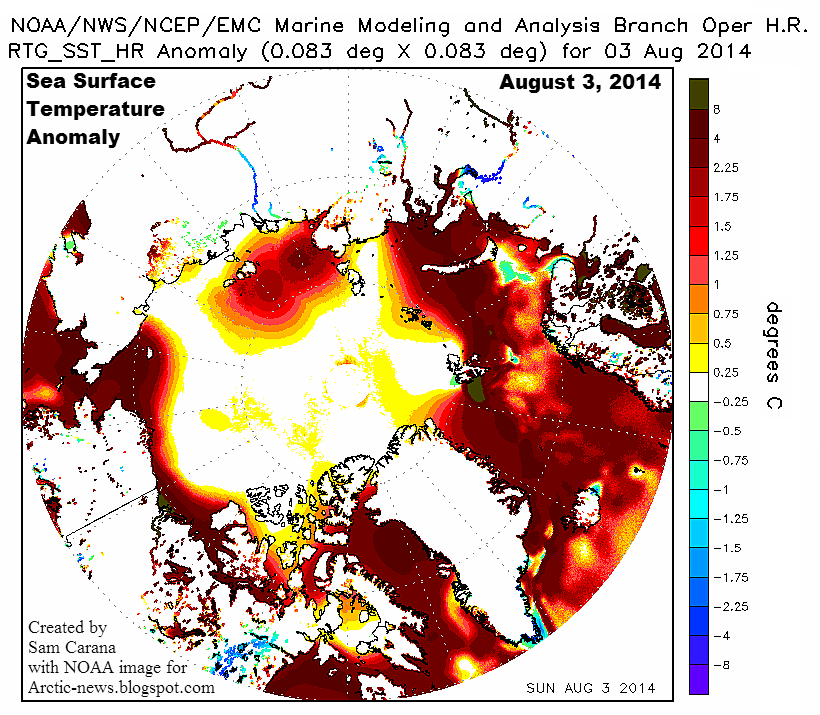
The very high sea surface temperature anomalies that show up on above image give an idea of the inflow of warm water from the Pacific Ocean through the Bering Strait. This is further highlighted by the combination image below.

[ click on image to enlarge ]
The situation is dire and calls for comprehensive and effective action, as discussed at the Climate Plan blog.


Friday, August 15, 2014

Heatwave to hit Greenland

A heatwave with temperature anomalies exceeding 36°F (20°C) is expected to hit Greenland between August 16 and 22, 2014, as illustrated by the image on the left and the animation on the right. 

Such heatwaves can be expected to hit the Arctic more frequently and with greater intensity, as temperatures in the Arctic are rising faster than elsewhere on Earth.

Such heatwaves can result in massive melting on Greenland, as persistent heat changes the texture of the snow and ice cover, in turn reducing its reflectivity. This makes that less sunlight is reflected back into space and is instead absorbed. 

The image below illustrates what a difference the presence of sea ice can make.
from: Arctic Warming due to Snow and Ice Demise
As the NSIDC/NOAA graphs below shows, melting on Greenland has been relatively modest this year when compared to the situation in 2012. By July 12, 2012, 97% of the ice sheet surface had thawed, according to this NASA analysis and this NOAA Arctic Report Card.


Melting on Greenland directly affects sea level rise, and melting on Greenland is accelerating due to a number of factors.

Projections of melting on Greenland have long been based on a warming atmosphere only, ignoring the warmer waters that lubricate glaciers and that warm Greenland's bedrock canyons that sit well below sea level.

Furthermore, there are growing quantities of black carbon deposits as a result of burning of fossil fuel and biomass. High temperatures have recently caused ferocious wildfires in Canada that have in turn caused a lot of black carbon to go up high into the atmosphere.

And of course, the atmosphere over the Arctic is warming up much faster than most models had projected. This in turn causes triggers further feebacks, including more extreme weather events such as heatwaves and rain storms that can be expected to hit Greenland with ever more frequency and ferocity. Further feedbacks include methane eruptions from the heights of Greenland, as discussed at the Arctic Feedbacks Page.

When also taking into account the accelerating impact of such factors on melting in Greenland, sea levels could rise much faster than anticipated, as illustrated by the image below.

from: more than 2.5m sea level rise by 2040? 

Note that sea level rise is only one of the many dangers of global warming, as discussed in the 2007 post Ten Dangers of Global Warming.

The image on the right shows a temperature forecast for August 16, 2014, with parts of Greenland changing in color from blue into green, i.e. above the melting point for snow and ice.

Such high temperatures are now hitting locations close to the North Pole ever more frequently, due to the many feedbacks that are accelerating warming in the Arctic, as discussed at this Feedbacks page.

One of the most dangerous feedbacks is a sudden eruption of huge quantities of methane from the seafloor of the Arctic Ocean, as discussed in a recent post.

The impact of such feedbacks can be accumulative and interactive, resulting in self-reinforcing feedbacks loops that can escalate into runaway warming.

Below is another forecast by ClimateReanalyzer for August 16, 2014, showing the remarkable ‘greening’ of Greenland, as well as the very high temperatures reaching the higher latitudes of North America.


Also see the very high sea surface temperatures around Greenland on the image below, created with ClimateReanalyzer.

Sea surface temperature anomalies on August 15, 2014. 
In conclusion, the situation is dire and calls for comprehensive and effective action, as discussed at the Climate Plan blog. 


Wednesday, August 13, 2014

Horrific Methane Eruptions in East Siberian Sea

A catastrophe of unimaginable propertions is unfolding in the Arctic Ocean. Huge quantities of methane are erupting from the seafloor of the East Siberian Sea and entering the atmosphere over the Arctic Ocean.


As the top image above shows, peak levels as high as 2363 ppb were recorded at an altitude of 19,820 ft (6041 m) on the morning of August 12, 2014. The middle image shows that huge quantities of methane continued to be present over the East Siberian Sea that afternoon, while the bottom image shows that methane levels as high as 2441 ppb were recorded a few days earlier, further indicating that the methane did indeed originate from the seafloor of the East Siberian Sea.

On August 12, 2014, peak methane levels at higher altitudes were even higher than the readings mentioned on above image. Levels as high as 2367 ppb were reached at an altitude of 36,850 ft (11,232 m). Such high levels have become possible as the huge quantities of methane that were released from the seafloor of the Arctic Ocean over the period from October 2013 to March 2014, have meanwhile descended to lower latitudes where they show up at higher altitudes.

Methane eruptions from the Arctic Ocean's seafloor helped push up mean global methane levels to readings as high as 1832 ppb on August 12, 2014.

Ironically, the methane started to erupt just as an international team of scientists from Sweden, Russia and the U.S. (SWERUS-C3), visiting the Arctic Ocean to measure methane, had ended their research.

Örjan Gustafsson describes part of their work: “Using the mid-water sonar, we mapped out an area of several kilometers where bubbles were filling the water column from depths of 200 to 500 m. During the preceding 48 h we have performed station work in two areas on the shallow shelf with depths of 60-70m where we discovered over 100 new methane seep sites.”

Örjan Gustafsson adds that “a tongue of relatively warm Atlantic water, with a core at depths of 200–600 m may have warmed up some in recent years. As this Atlantic water, the last remnants of the Gulf Stream, propagates eastward along the upper slope of the East Siberian margin, our SWERUS-C3 program is hypothesizing that this heating may lead to destabilization of upper portion of the slope methane hydrates.”

Schematics of key components of the Arctic climate-cryosphere-carbon system that are addressed by the SWE-C3 Program. a,b) Sonar images of gas plumes in the water column caused by sea floor venting of methane (a: slope west of Svalbard, Westbrook et al., 2009; b: ESAO, Shakhova et al., 2010, Science). c) Coastal erosion of organic-rich Yedoma permafrost, Muostoh Island, SE Laptev Sea. d) multibeam image showing pockmarks from gas venting off the East Siberian shelf. e) distribution of Yedoma permafrost in NE Siberia. f) Atmospheric venting of CH4, CO2. (SWERUS-C3)
Örjan Gustafsson further adds that SWERUS-C3 researchers have on earlier expeditions documented extensive venting of methane from the subsea system to the atmosphere over the East Siberian Arctic Shelf.

In 2010, team members Natalia Shakhova and Igor Semiletov estimated the accumulated methane potential for the Eastern Siberian Arctic Shelf alone to be as follows:
- organic carbon in permafrost of about 500 Gt;
- about 1000 Gt in hydrate deposits; and
- about 700 Gt in free gas beneath the gas hydrate stability zone.

Back in 2008, Shakhova et al. wrote a paper warning that “we consider release of up to 50 Gt of predicted amount of hydrate storage as highly possible for abrupt release at any time.”

Last year, a team of researchers including Professor Peter Wadhams calculated that such a 50 Gt release would cause global damage with a price-tag of $60 trillion.

As Prof Wadhams explains in the video below: “We really have no choice except to seriously consider the use of geoengineering.”


Sea surface temperatures as high as 18.8°C are now recorded at locations where warm water from the Pacific Ocean is threatening to invade the Arctic Ocean.

At the same time, huge amounts of very warm water are carried into the Arctic Ocean by the Gulf Stream through the North Atlantic. The image below illustrates how the Gulf Stream brings very warm water to the edge of the sea ice.

Waters close to Svalbard reached temperatures as high as 62°F (16.4°C) on July 29, 2014 (green circle). Note that the image below shows sea surface temperatures only. At greater depths (say about 300 m), the Gulf Stream is pushing even warmer water through the Greenland Sea than temperatures at the sea surface.

Since the passage west of Svalbard is rather shallow, a lot of this very warm water comes to the surface at that spot, resulting in an anomaly of 11.1°C. The high sea surface temperatures west of Svalbard thus show that the Gulf Stream can carry very warm water (warmer than 16°C) at greater depths and is pushing this underneath the sea ice north of Svalbard. Similarly, warm water from greater depth comes to the surface where the Gulf Stream pushes it against the west coast of Novaya Zemlya.


[ click on image to enlarge ]
As Malcolm Light writes in an earlier post: The West Spitzbergen Current dives under the Arctic ice pack west of Svalbard, continuing as the Yermak Branch (YB on map) into the Nansen Basin, while the Norwegian Current runs along the southern continental shelf of the Arctic Ocean, its hottest core zone at 300 metres depth destabilizing the methane hydrates en route to where the Eurasian Basin meets the Laptev Sea, a region of extreme methane hydrate destabilization and methane emissions.

The images below give an impression of the amount of heat transported into the Arctic Ocean.


The image below gives an idea how methane eruptions from the seafloor of the Arctic Ocean could unfold over the coming decades. For more on this image, see this post and this page.


As said, the situation is dire and calls for comprehensive and effective action, as discussed at the Climate Plan blog at climateplan.blogspot.com and as illustrated by the image below.


Sunday, August 10, 2014

The Grand Central Market, Almost a Hundred Years Old and the Hottest Destination in Downtown Los Angeles

Located on Broadway and Hill between 2nd and 3rd, The Grand Central Market reflects the changes sweeping over Downtown Los Angeles. Long before farmers markets appeared all over LA, the Grand Central Market provided the Downtown community with fresh food at affordable prices.


The shoppers who filled the aisles, bought fresh produce, fruit, fish, meat and poultry. Freshly made tortillas traveled down a conveyer belt where they were stacked in plastic bags and sold still warm in the open-air tortilla factory that once stretched along the southern wall close to Broadway .


The Market specialized in health products, fresh fruit juices, herbal teas and homeopathic remedies from around the world.
And where there are shoppers, they will be places to eat. Dozens of stalls sold Mexican tacos, enchiladas, ceviche, whole lobsters, plates of fried fish and shrimp in the shell. Anyone who needed an old-school Chinese-American food fix could eat at China Cafe and Broadway Express.
Today, many of the vendors have been at the Market for generations. On the Broadway side next to the floor-to-ceiling Grand Central Liquor, you can't walk by Las Morelianas without being offered a taste of their delicious roast pork inside a freshly made mini-tortilla. A personal favorite, to the moist meat I add  mounds of pickled onions and carrots, chopped raw onions and cilantro and a liberal dousing of green chili sauce all freshly made.
I first visited the market when I was in college. I bought spices at Valeria's and the ready to use mole paste at the very misnamed A&B Coffee where I could also buy any one of a dozen different dried beans. I wanted to learn how to make tortillas at home. I came to the Market to buy masa and a tortilla press. The tortillas were good, but, I had to confess,  the ones I bought at the Market were better so I kept coming.
In the late 1970's I photographed the Market to use for a TV pilot I was producing for KCOP. I took a hundred photographs of the vendors and customers. I loved the community feeling of the Market. Families with babies in tow shopped for the basics and stopped to have snacks or lunch.
Today the market still has families doing their daily shopping but they have been joined by a new population, eager to explore the newly arrived vendors who have set up shop and added new flavors and culinary experiences.
To keep that new population updated, LA food blogs track the latest the developments at the Market. Upscale purveyors like DTLA Cheese and Belcampo Meat Co. have opened stalls with counter seating, selling high quality products previously only available in specialty stores in Beverly Hills or Hancock Park. Customers wait patiently in line for their turn to order at McConnell's Ice Cream, Sticky Rice - Thai Street Food, Egg Slut and Wexler's Deli. Compared to the original vendors, the new comers are definitely more upscale and more expensive.

I have my favorites and they are a mix of the old and the new:  the mole at A&B Coffee (ask for a taste and find the one you like), pork ramen at Bento Ya, the vegetable curry with shrimp and Crying Tiger beef at Sticky Rice, the roast pork tacos at Las Morelianas with lots of salsas and pickled vegetables and the beef at Belcampo Meat Co. (terrific although pricey, Jared Standing, Head Butcher suggested I try one of the less expensive cuts, the chuck eye steak and it was delicious!).
The produce stands that are still in the market are very old school. The fruits, vegetables and berries are sometimes a great bargain and sometimes not so great. I can always find root vegetables at a good price. And on occasional seasonal berries that are half the farmers market price.

A balancing act

At this moment in time, the Market is perfectly balanced between the new and the old so that I can indulge my passion for affordable ethnic food and quality products from specialty purveyors.

The old and the new are pressed together in a mash up that reflects what's happening Downtown. The mostly Latino population has been joined by a diverse mix of young professionals who have rediscovered the glories of Downtown Los Angeles, rich with history and benefiting from a great collection of buildings that are now being renovated and modernized.
Before that rediscovery, the Market had fallen on hard times. Local shoppers had turned to farmers markets for better produce. One by one stalls closed for lack of customers. The grit and grime of the city settled heavily onto the walls and floors. The Market had grown sad and forlorn.
But today, the Market is one of the most frequented Downtown destinations. Come during the day and the aisles are packed. The large indoor patio on the Hill side is filled with families and professionals enjoying a large bowl of ceviche from Lupita's Seafood, a taco plate from Sarita's Pupuseria, Wexler's house smoked lox on a freshly baked bagel and Bento Ya's $5.00 pork ramen that, in my opinion, is as good as any of the celebrity-chef bowls on Sawtelle or in Manhattan sold at three times the price and half the portion.
There is so much more to say about the Market, but I'm getting hungry. Happily I brought home a bowl of Bento Ya's ramen and I'm going to have that for breakfast.

One quick user's-tip about parking. Parking Downtown is very expensive. Happily, there is 60 minutes free parking inside the Market building.

The entrance is on the Hill Street side, almost to 2nd street. Spend $10.00 and ask the vendor to stamp your parking ticket. Go to the Security Desk next to the China Cafe for validation, then (yes, you still have one more step) go up the stairs to the parking garage and to your left you'll see a parking kiosk. Put your ticket in and you'll be told if you owe any money. Take the validated ticket with you to use at the exit.

On the weekend, the open air parking lots to the north of the Market above 2nd Street have reduced, all day rates, so if you are staying for several hours, park there.

I'll write more about the Market in coming weeks. Until then, I hope you take the time to visit the Market yourself.

Grand Central Market, 317 S. Broadway, Los Angeles, CA 90013 (213/624-2378), Sunday-Wednesday 8:00am-6:00pm, Thursday-Saturday 8:00am-9:00pm (selected vendors only open past 6:00pm).

Friday, August 8, 2014

The Arctic Methane Monster's Rapid Rise


Researcher Jennifer Hynes recently gave a frightening presentation about the situation in the Arctic and the odds that things will rapidly spiral out of control soon, escalating into runaway global warming a few decades from now. 


Above, a slide from the presentation, warning about the danger of earthquakes causing methane hydrate destabilization (from: Smoke Blankets North America). As the map below shows, 77 M4+ earthquakes did hit locations around Greenland in the year 2014 up until August 4.


Below is Jennifer's presentation, also on youtube at youtube.com/watch?v=a9PshoYtoxo


The image below shows sea surface temperature anomalies in the Arctic at August 7, 2014.


Warm water is carried into the Arctic Ocean by the Gulf Stream, as illustrated by the image below.
[ click on image to enlarge ]
The image shows how the Gulf Stream brings warm water to the edge of the sea ice. Waters close to Svalbard reached temperatures as high as 15.6°C (60.1°F) on August 8, 2014 (green circle). Note that what the image shows are sea surface temperatures only. At greater depths (say 300 m), warm water is pushed through the Greenland Sea by the Gulf Stream. Since the passage west of Svalbard is rather shallow, a lot of this warm water comes to the surface there. The high sea surface temperatures west of Svalbard thus indicate that the Gulf Stream is carrying very warm water (warmer than 15°C) at greater depths and is pushing this underneath the sea ice north of Svalbard.

As said, the situation is dire and calls for comprehensive and effective action, as discussed at the Climate Plan blog at climateplan.blogspot.com and as illustrated by the image below.


Monday, August 4, 2014

752 Reasons to Submit Your Film to the Short Food Movie Project at the Rome Film Festival 2014 & Expo Milan 2015

The Short Food Movie Project – Feed your Mind, Film your Planet is doing something pretty amazing.

Win an all-expense paid trip to Rome

Foodie-Filmakers have the opportunity to share their work in a unique setting. Anyone over sixteen can submit a 30 to 60 second video to the Short Food Movie Project before September 10, 2014 to be eligible to win an all-expense paid trip to the 2014 Rome Film Festival.

The videos should be about food related topics. Filmmakers can talk about what interests them: the environment, recipes, food policy, culture, nutrition, hunger or sustainable food production.

Rome is the first stop on the way to EXPO Milan 2015.

One film will be a winner, chosen by crowd-sourcing. The movie with the most “likes” on the Project’s web site will be shown at the Rome Film Festival, which is held between October 16th– 25th.

One movie screens in Rome, all the movies screen in Milan

All the movies uploaded to the web site before March 31, 2015 will be screened on a giant Samsung video wall constructed out of 752 screens in Pavilion Zero at the entrance to the Expo.
 

According to Project coordinator, Diamara Parodi Delfino, the shorts can be animations, narratives or docs. The production values can be simple or visually complex. Given the short length of thirty to sixty seconds, the films need to make simple statements.

When all the films are curated, the video wall of screens will be a visualization of EXPO MILAN’s central themes of Feeding the Planet.Energy for Life.  

Look at the web site and it’s apparent how widely different the shorts can be.

Every movie is unique

If a minute seems like a short amount of time to make a statement, some filmmakers need even less. In thirty-five seconds, Mauro Jonathan Manzo creates a dizzying “Mosaic of Food” to celebrate the foods we love: soups, hamburgers, shawarma, French fries, sunny side eggs, pizzas, desserts, fresh berries, sausages on a grill and a pastry with whipped cream.
 
Using a low-res camera and a simple narrative, Greta Gabriel’s “Naturale” watches as two young women take very different culinary paths. One woman watches TV, drinks a soda and eats a hamburger filled with nuts and bolts while the other enjoys a green salad, a bowl of fruit and a glass of water. The result of their different diets is immediately apparent. The hamburger-woman looks ill and exhausted after her meal while the natural-woman walks happily on the beach. Sure it's didactic but the contrast of a sensible diet with one that disregards health is a lot of fun.

Many of the shorts go into kitchens to illustrate the making of a favorite dish. Grace Hsia’s “Shall We Eat Homemade Dumplings” lovingly details how to make pierogies according to an American friend’s recipe.

“Your Word for Food” Belgium’s Aurélie Duray created a montage of stills showing people from around the world holding up a small blackboard with their one word description of food. The words come fast and furiously: joy, satisfaction, pleasure, rice, grain, carrots, quality hunger, balance, inequality, life…. The list goes on and on, ending with a question for the viewer: “What’s your word?”

From the U.S. in “Be the Change: 3 Meals a Day,” Sarah Gulick uses title cards to create a peppy, thirty-eight second film that makes the case that every one of us can help save the planet if we eat green.

Italy’s Emilia Garuti shows people and animals eating in his impressionistic, 59 second long “´E Ora di Pranzo” (“It’s lunch time”): a woman in a small kitchen making tortellini for nursing home residents, cows being fed, a butterfly hovering over a flower and a man in his city patio feeding chickens.

France’s Simon Bonanni goes to the dark side in a comic look at two young men who load up on supermarket food for a road trip in “Chevaliers” (“Knights”). Overcome by a savage hunger, they rip open bags of chips and junk food as they drive down a quiet country road.

Diamara Parodi Delfino encourages everyone to take their cue from the movies already uploaded to the site. Any one who has a professional camera, a point-and-shoot camera, a tablet or a smart phone, start shooting and UPLOAD your movie so you can be part of the fun.


Warm waters threaten to trigger huge methane eruptions from Arctic Ocean seafloor

The evidence of abrupt high methane releases in the Arctic Ocean is accumulating. The graph below shows in situ methane measurements taken at the Barrow Observatory, including recent levels as high as close to 2200 parts per billion (ppb).


Satellite data picture a similarly dire situation. Global mean methane levels as high as 1831 ppb were recorded on the morning of July 30, 2014, while peak methane levels as high as 2330 ppb were recorded that morning. More recently, peak methane levels as high as 2522 ppb were recorded (on August 2, 2014).

IPCC/NOAA figures suggest that methane levels were rising by some 5 to 6 ppb annually, reaching 1814 ppb in 2013. While methane levels at lower altitudes have indeed shown little rise, much larger rises have been recorded at higher altitudes, as illustrated by the image below.


These high methane levels recorded at higher altitudes appear to be caused by the huge quantities of methane released from the seafloor of the Arctic Ocean during the period from end 2013 to early 2014. This methane has meanwhile risen to higher altitudes, while also descending to lower latitudes, wreaking havoc on weather patterns around latitude 60° North.

The releases of methane from the seafloor of the Arctic Ocean were caused by water that had warmed up strongly off the east coast of North America from June 2013. It took some months for this warm water to be carried by the Gulf Stream into the Arctic Ocean.


Meanwhile, very high sea surface temperatures are recorded in the Arctic Ocean, as above image shows, while warm water is carried into the Arctic Ocean by the Gulf Stream, as illustrated by the image below.


As said, the situation is dire and calls for comprehensive and effective action, as discussed at the Climate Plan blog.