Monday, January 26, 2015

Planetary Genocide - Ecocide between 2023 and 2031

by Malcolm Light


click on image to enlarge


References and Further Reading

- State Of Extreme Emergency, by Malcolm P.R. Light

- Focus on Methane, by Malcolm P.R. Light
http://arctic-news.blogspot.com/2014/07/focus-on-methane.html

- Arctic Atmospheric Methane Global Warming Veil, by Malcolm P.R. Light, Harold Hensel and Sam Carana
http://arctic-news.blogspot.com/2014/06/arctic-atmospheric-methane-global-warming-veil.html


Andrew Harvey Interviews Guy McPherson


Andrew Harvey, founder & director of the Institute for Sacred Activism, interviews Dr. Guy McPherson on the topic of how to live with death in mind. Harvey reads excerpts from his foreword in Dr. McPherson and Carolyn Baker's new book, 'Extinction Dialogs: How to Live With Death in Mind'.


Links

Follow Guy McPherson's European Trip March/April 2015
https://www.facebook.com/pages/Guy-McPherson-European-Trip-MarchApril-2015/1381860682059663

Nature Bats Last at Youtube
https://www.youtube.com/channel/UCyerZPyOwZdwRQtV66L6VTA

Andrew Harvey
http://www.andrewharvey.net

Guy McPherson
http://guymcpherson.com

Interview with Andrew Harvey

Citrus Pistachios and Vietnamese Spicy Wings Heat Up Super Bowl Sunday Snacks

What are you going to serve on Super Bowl Sunday? Chips and dips, frozen pizza and grocery store salads. No way! Special events deserve special food. Snacks that reach out and grab you, that make you stop watching TV and say, "That is amazing!"

Here are two of my favorite snacks. One, the pistachios, I figured out last week. The other, the Vietnamese-style wings are a long time favorite. What they have in common is an addictive salty-sweet heat.

Have a great game!

Citrus Pistachios

My only debate about this snack is whether to use pistachios in the shell or shelled. Personally I like the fun of cracking open the shells. If you want easy-snacking, use the shelled pistachios. 
I prefer to use raw pistachios. If the only pistachios available are already roasted, check to see if they are also salted. In which case, do not salt the nuts.

Serves 10-12

Ingredients

16 ounces pistachios (in the shell or shelled)
1 cup citrus peel (oranges, grapefruit or tangerines), fresh, washed, dried
1/2 teaspoon sea salt (do not use salt if the pistachios are already salted)
1/4 teaspoon dried oregano
1/4 teaspoon dried rosemary
1/4 teaspoon dried tarragon 
1/2 teaspoon raw sugar
Pinch cayenne 
Directions

Using a sharp chefs knife, cut the peels off the citrus of your choice. I like a mix of flavors, so I use equal amounts of grapefruit, orange and tangerine peels. Once you have removed the peels, you can cut the citrus into segments and make a delicious fruit salad by adding cut up apples and pomegranate seeds. 
Lay the peels out on a cutting board and select portions of the peel that are unblemished. Use a sharp knife to carefully remove most of the pith from the back of the peel. Leave a little white layer for flavor. Cut the peels into thin ribbons approximately 1/8 inch thin.

Heat a nonstick pan on a medium flame. Add the citrus peel, spices, sea salt and sugar. Toss frequently. The goal is to flavor and dehydrate the peels.

When the citrus peels are lightly browned and crisp, remove from the pan. Using the same pan, heat the pistachios and toss until lightly browned.

In a bowl mix together the citrus peels and pistachios. 

Serve warm in a bowl.

Spicy Sweet Ginger-Garlic Chicken Wings

Make the wings a day or two ahead. Reheat the wings just before half-time and feast.

Serves 4 as an entrée or 8 as an appetizer
Ingredients

2 pounds chicken wings, washed, disjointed, wing tips discarded or reserved and used to make stock
½ cup white sugar
½ cup warm water
¼ cup fish sauce--preferably a light caramel colored brand
¼ cup white vinegar
2 teaspoons fresh lime juice
4 cloves garlic minced
1 dried Chinese Szechuan pepper, stem removed, seeds and skin minced
3 tablespoons or 3” ginger, peeled, minced
2 tablespoons brown sugar, to taste

Directions

Preheat oven to 350 F.

In a large non-reactive bowl, dissolve sugar in warm water. Add other ingredients, stir to mix well. Place chicken in marinade. transfer to a sealable plastic bag and refrigerate one hour or, preferably, overnight.

When ready to cook, separate wings from the marinade. Pour the marinade into a small saucepan. Add brown sugar. Stir to dissolve. Over a low flame, reduce by half. Taste and adjust for more sweetness if desired by adding more brown sugar.

Line a large baking sheet with a sheet of aluminum foil for easy clean up. 

Place in oven. Turn every ten minutes. Cook until tender, about thirty minutes.

Serve on a plate of Asian noodles, steamed rice or shredded lettuce. Just before serving, pour the heated marinade over the top of the wings.

Monday, January 19, 2015

Temperature Rise

Record High Temperatures in 2014

The year 2014 was the warmest year across global land and ocean surfaces since records began in 1880, writes NOAA, adding the graph below. This graph illustrates that temperatures have risen even when focusing on a relatively short recent period with a linear trendline starting in 1998, which was an El Niño year, whereas 2014 wasn't.

Source: NOAA Global Analysis - Annual 2014
Most Appropriate Trendline

While the purple 1998-2014 trendline serves the useful purpose of dispelling the myth that warming had halted recently, it isn't the most appropriate trendline, since extending this trendline backward to 1880 would leave too many data too remote from the trendline, as is further illustrated by the animated image below.


What about the blue linear trendline that is based on data for all the years from 1880 to 2014? By that same logic, the appropriateness of this trendline must also be questioned. Temperatures in recent years have been well above this trendline. A polynomial trendline seems a much better fit, as illustrated by the image below.


Above image also extends the trendline forward, showing that 2 degrees Celsius warming looks set to be exceeded in 2038, based on the same data.

And while this is a frightening scenario, the picture may well be much too optimistic, because the heat is felt most in the Arctic Ocean, the very location where some of the most terrifying feedbacks are accelerating local warming, as further explained below.

Feedbacks in the Arctic

As NOAA writes, much of the record warmth for the globe can be attributed to record warmth in the global oceans, which reached the highest temperature among all years in the 1880–2014 record.


As above image shows, ocean heat reached a record high in 2014. In other words, it was ocean heat that pushed the combined ocean and land temperature to a record high. Anomalies were especially high in the Arctic Ocean, as illustrated by the image below.


Waters close to Svalbard reached temperatures as high as 63.5°F (17.5°C) on September 1, 2014 (green circle). Note that the image below shows sea surface temperatures only. At greater depths (say about 300 m), the Gulf Stream is pushing even warmer water through the Greenland Sea than temperatures at the sea surface.


Since the passage west of Svalbard is rather shallow, a lot of this very warm water comes to the surface at that spot, resulting in an anomaly of 11.9°C. The high sea surface temperatures west of Svalbard thus show that the Gulf Stream can carry very warm water (warmer than 17°C) at greater depths and is pushing this underneath the sea ice north of Svalbard.


Planetary energy imbalance (0.6 W/m2) equals the amount of energy in exploding 400,000 Hiroshima atomic bombs per day, 365 days/year (J. Hansen, 16 Jan. 2015).


Planetary imbalance now is 0.6 W/m2. This has made the rise in ocean heat (up to 2000 m deep) more than double over the past decade. Data from 2005 through to 2014 contain a polynomial trendline that points at a similar rise by 2017, followed by an even steeper rise.

What could cause such non-linear rise?

The answer is feedbacks. Arctic snow and ice loss alone may well cause over 2 W/m2 warming, warns Prof. Peter Wadhams. Another such feedback is methane erupting from the ocean floor, as methane hydrates get destabilized due to higher temperatures.

As illustrated by the graph below, most of this excess heat is absorbed by oceans and ice. Some of the heat is consumed by the process of melting ice into water, and 93.4% of this excess heat ends up warming up the oceans.

Graph by Sceptical Science based on study by by Nuccitelli et al.
As the Gulf Stream keeps carrying ever warmer water into the Arctic Ocean, methane gets released in large quantities, as illustrated in the images below showing high methane levels over the East Siberian Arctic Shelf (red oval left) and over Baffin Bay (red oval right) with concentrations as high as 2619 ppb.

click on image to enlarge
The images below show methane levels on Jan 25 (top), and Jan 26, 2015 (bottom).


The threat is that huge amounts of methane will erupt from the seafloor of the Arctic Ocean over the coming decades, as illustrated by the image below.

For more on this image, see this post and this page.
Demise of the Arctic sea ice and snow cover is another terrifying feedback. The image below features a NASA/Goddard Space Flight Center Scientific Visualization Studio screenshot showing decline of multi-year Arctic sea ice area over the years.


Below is a video by Nick Breeze who interviews Professor Peter Wadhams on multi-year Arctic sea ice.


An exponential trendline based on sea ice volume observations shows that sea ice looks set to disappear in 2019, while disappearance in 2015 is within the margins of a 5% confidence interval, reflecting natural variability. In other words, extreme weather events could cause Arctic sea ice to collapse as early as 2015, with the resulting albedo changes further contributing to the acceleration of warming in the Arctic and causing further methane eruptions from the seafloor of the Arctic Ocean.

click on image to enlarge
As the Arctic continues to warm, the temperature difference between the equator and the Arctic declines, resulting in changes to the jet streams and polar vortex.

One such change is a slowing down of the speed at which the jet streams and polar vortex circumnavigate the globe, as discussed in a recent post.

The image on the right shows that the jet streams on the Northern Hemisphere reached speeds as high as 410 km/h (255 miles per hour) on January 9, 2015. Also note the jet stream crossing the Arctic Ocean, rather than staying between 50 and 60 degrees latitude, where the polar jet streams used to be.

The image below shows winds on January 11, 2015, at several altitudes, i.e. at 10 hPa | ~26,500 m (16.5 mile), high in stratosphere, polar vortex (left, at 250 hPa | ~10,500 m (6.5 mile), jet stream (center), and at 700 hPa | ~3,500 m (2.2 mile), high in planetary boundary layer.

click on image to enlarge
As a result, extreme weather events such as heatwaves and storms can be expected to occur with greater frequency and intensity, as also discussed in a recent post. Heatwaves can heat up the water in the North Atlantic, as it flows into the Arctic Ocean, driven by the Gulf Stream, while heatwaves can also warm up the water in rivers that end up in the Arctic Ocean. Heatwaves can also hit the sea ice in the Arctic Ocean directly, causing rapid sea ice melting, while storms can make the ice break up and be driven out of the Arctic ocean,

Demise of the sea ice and snow cover in the Arctic results in further acceleration of warming, not only due to less sunlight getting reflected back into space, but also due to loss of the buffer that currently absorbs huge amounts of heat as it melts in summer. With the demise of this latent heat buffer, more sunlight will instead go into heating up the water of the Arctic Ocean. For more on the latter, see the page on latent heat.


Above image illustrates some of the self-reinforcing feedback loops that have been highlighted in this and earlier posts. Further feedbacks are pictured in the image below.

from the Feedbacks page
Runaway Global Warming

Above feedbacks are already pushing the temperature rise in the Arctic through the 2°C guardrail.


Based on existing temperature data, global warming on land looks set to exceed 2°C (3.6°CF) warming by the year 2034, but methane eruptions from the seafloor of the Arctic Ocean could push up global temperature rise even faster, in a runaway global warming scenario.

click to enlarge image
This raises the specter of human extinction. With no action taken, there appears to be a 55% risk that humans will be extinct by the year 2045, while taking little action will only postpone near-term human extinction by a few years. Only with rapid implementation of comprehensive and effective action may we be able to avoid this fate.


Comprehensive and Effective Action

In conclusion, the situation is dire and calls for comprehensive and effective action, as discussed at the Climate Plan blog at climateplan.blogspot.com and as illustrated by the image below.


Monday, January 12, 2015

Lentil-Veggie Stew, a One Pot Winter Pleasure

Over the weekend, the rain beat down steadily all day. At first more like a mist at a car wash, then in steady sheets that drenched any one deciding the time was perfect to visit a favorite restaurant. Which is exactly what we did. We met our sons at Yabu in West Los Angeles (11820 W. Pico Blvd, Los Angeles, CA 90064, 310-473-9757)  for a 2015 New Year's dinner.

With the weather outside cold and wet, we were happy to be inside the busy, warm restaurant. We ordered our favorite dishes: udon with mushrooms, tempura vegetables and shrimp on seasoned rice, salmon sashimi with pale white daikon threads & wispy pickled seaweed, spinach salad seasoned with mirin and sesame paste, sea urchin (uni) sushi with quail yolk, egg omelet sushi (tamago), baked crab hand roll and hot soba in soup with thinly sliced scallions and paper thin sheets of fatty duck breast.
We talked, shared a bottle of hot sake and looked at photographs from our holiday trips. A great way to begin the new year.

Yesterday the rain was reduced to a light drizzle. Not enough to soak through a thick sweater but enough to chill skin and bone. When it was time to think about dinner, I had only one thought. Cook something easy. Cook something in one pot. And make sure it is hot, filling and delicious.

A few years ago a press trip took me Spokane, Washington and Moscow, Idaho. The area is well-known for its agricultural products, most importantly lentils. A representative of the USA Dry Pea & Lentil Council gave us a "Lentils 101" talk that described the many varieties of lentils, their nutritional value and economic importance to protein-starved regions of the world. Each of us was given a copy of The Pea & Lentil Cookbook: From Everyday to Gourmet which has recipes using dried legumes in dishes as varied as appetizers, soups, salads, entrees and desserts.

Cooking with lentils is easy.

The basics are wash and rinse the lentils. Discard any broken or misshapen lentils. Generally speaking lentils are cooked in water at a ratio of one cup of lentils to two and a half cups of water. Simmer covered for 30-50 minutes, tasting the lentils as they cook and removing the pot from the stove when they are to your taste. Cooked longer, lentils will soften and can be used in purees for soups, dips, sauces and spreads.

I like the lentils to retain their shape so I cook them only until they are al dente.

Lentils with Shiitake Mushrooms and Vegetables

Lentils come in many varieties. They are not all the same. Find the ones you like. My favorites are Beluga or black lentils and Spanish pardina lentils, which I used last night.

Roasted tomato sauce adds a pleasing acid. Canned tomato sauce may be used, but a better alternative is to make your own. For Zester Daily I wrote about making roasted tomatoes and sauce to keep in your freezer.

Serves 4

Ingredients

1 cup lentils
2 1/2 cups water
1 tablespoon olive oil
1/4 teaspoon sea salt
1/8 teaspoon freshly ground black pepper
Pinch of cayenne (optional)
1/4 teaspoon ground cumin
1/4 teaspoon turmeric powder
1 garlic clove, washed, skin removed, minced
1 medium sized yellow onion, washed, paper skin, root and stem ends removed, finely chopped
2 cups mushrooms, preferably shiitake or brown, washed, the ends of the stems removed, finely chopped
1 medium sized carrot, stem cut off, peeled, washed
1 large roasted tomato, washed, stem removed or 1/2 cup roasted tomato sauce
2 cups spinach leaves, washed and thin sliced

Directions

Rinse the lentils, discarding any that are broken or discovered.

In a 2 quart sauce pan, heat the olive oil. Add the dry spices and garlic. Lightly brown.

Add the onions, mushrooms and carrots. Saute until lightly browned.

Add the lentils, water and roasted tomato sauce. Stir well. Bring to a simmer. Cover.

After 15 minutes, add the spinach leaves. Stir well. Cover.

The lentils may take 25-45 minutes to soften. How long depends on many factors. After 25 minutes, taste a few lentils. If they need more cooking and the liquid has evaporated, add enough water to keep the lentils covered.

Stir well, cover and continue cooking, checking the pot every 5 minutes until they have achieved the desired texture.

Serve hot.


Tuesday, January 6, 2015

Edge of Extinction

Guy McPherson
Guy McPherson is convinced that humunity will go extinct soon. Guy estimates that it will happen in 5 to 20 years time.

In the video below, Guy discusses a chain of events causing several degrees warming within a few years time, including failure of the electric grid and subsequent fall in aerosols from fossil fuel burning that now mask warming, and failure to maintain nuclear power plants cooling, causing them to melt down.

These events will cause rapid warming that will accelerate loss of the snow and sea ice in the Arctic and cause massive methane releases from the seafloor of the Arctic Ocean, both adding even further warming.

Such massive warming will result in widespread crop failure and loss of habitat for humans over a timespan of up to 20 years, while events could all unfold in just 5 years time.

In the video below, Guy discusses that we are on the edge of extinction, episode 1.


Feedbacks
 

Professor Peter Wadhams on albedo changes in the Arctic

Conclusion from a paper presented at the 2008 EGU conference, on background
of a frame from a video interview by Nick Breeze with Natalia Shakhova.


In the video below, episode 2, Guy describes how large releases of methane from the seafloor of the Arctic Ocean alone could end civilization, as they will cause crop failure on the Northern Hemisphere and subsequent collapse of civilization. This will in turn cause failure of the electric grid, etc., as described above. So, whatever event comes first, it will trigger the other events, resulting in several degrees Celsius warming within years and loss of habitat for humans.


The image below highlights some of the complexities associated with the necessary cuts in emissions, including the impact of aerosols that mask the full wrath of global warming by half. In 2007, the IPCC described aerosols as a negative (cooling) force equal to between -0.5 and -2.5 W m-2. In 2009, Murphy et al suggested an aerosol forcing about -1.5 W m-2, reducing the net climate forcing of the past century by about half. In 2011, Hansen et al, based mainly on analysis of Earth's energy imbalance, derived an aerosol forcing -1.6 ± 0.3 W m-2. [source] As David Spratt points out, this equates to a cooling of about 1.2°C. In other words, abrupt ending of aerosols emissions would result in a temperature rise of about 1.2°C in a matter of weeks.


In the video below, Guy McPherson further discusses the impact of aerosols.


Below, 'Edge of Extinction', episode 3, published on 15 January, 2015, featuring Guy McPherson in a fine moment of comedy! Excerpt from his presentation at Butte College, November 20, 2014, Chico, California.


Below, 'Edge of Extinction', episode 4, published on 21 January, 2015, in which Guy comments on the State of the Union address of January 20, 2015.


Below, 'Edge of Extinction', episode 5, published on 27 Jan 2015, featuring an excerpt from Guy McPherson's interview on Global Research December 12, 2014 on the stages of grief. 


Follow Guy McPherson's European Trip March/April 2015


Friday, January 2, 2015

Strong winds threaten to push sea ice out of Arctic Ocean

By Albert Kallio


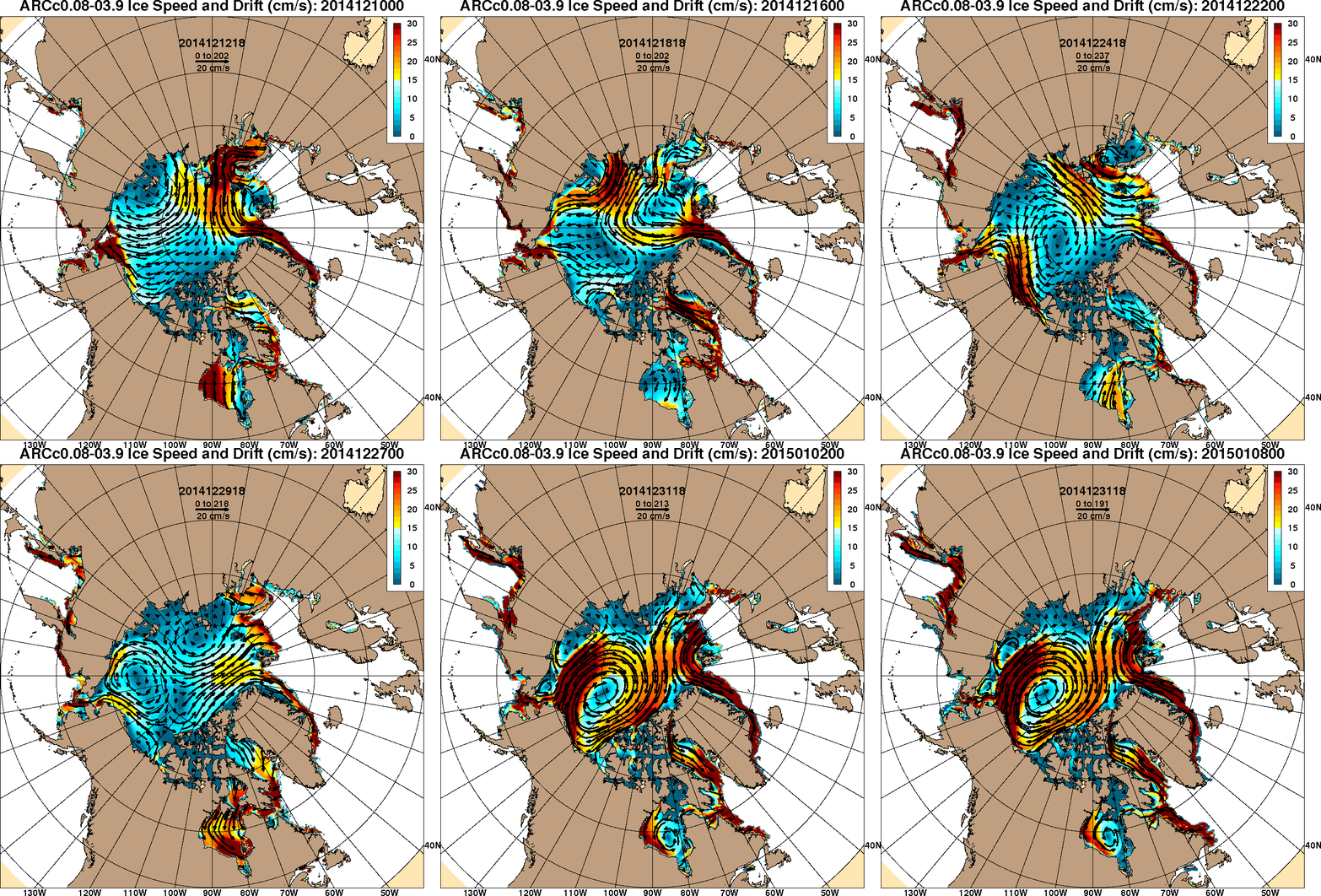
The lateral viscosity of the thin Arctic sea ice cover continues to lower. In November just one quarter of the high Arctic Ocean basin above 85° north was covered by a thin this winter's ice. This has now doubled, soon covering two quarters. The ice has been pushed away from Russia towards Canada and to the Fram Strait at phenomenal rates.
 
Animation by navy.mil showing 30 days of sea ice thickness, up to January 1, 2015
This is increasingly suggesting that the remaining half in front of the Fram Strait will be sucked into the Atlantic Ocean soon. The dark blue ice is newly formed crushed ice behind the North Pole (pack ice). We may well be in course to the first recorded ice free season in the Arctic Ocean. In addition, the rear is pushed from behind Canada to the Beaufort and Chukchi Seas.

Animation by navy.mil showing 30 days of sea ice speed and drift, up to January 1, 2015

We need to act, now. I think we need to monitor this development almost on daily basis. I am curious to see how the ice may behave after the last remainders of the second quarter are sucked into the Atlantic Ocean and the newly forming sea ice will face the force of the Atlantic waves. That could mean extremely highly fractured sea ice across the Russian side by the return of spring 2015 sunlight.

I think we are witnessing a historic transition right now with no ice in the summers.