
Thursday, March 15, 2012

Wednesday, March 14, 2012
Chaos and Cupcakes

I need help completing the following:
The way to a woman's heart is.....
I raise this in the context of that old simplistic generalization:
The way to a man's heart is via his stomach.
Let me be clear that I'm not about to defend - even in jest - this kind of aphorism. To do so thesedays requires sixty-five pages of exceptions, eight declarations about domestic stereotypes and a dozen portion size disclaimers. What I will say is that any woman who presents me with a hot plate of beautifully roasted chicken, fresh green vegetables and a small serving of garlic mashed potato might find herself the object of my (relationship-appropriate) affection.
Just sayin'.
Here's one possible answer to my question.
Bottoms Up, Food Networkers.
Tuesday, March 13, 2012
Pistachio Cherry Pesto
I'm not sure that this can even be called a pesto. I've gone beyond nuts and herbs, and didn't even add any cheese! The horror! What I can say, is that this is tasty. And unique. A little savory-sweet action going on, which should come as no surprise. I'm going to spare you the photo I took of the pesto on its own, because, well... it doesn't look appetizing ;)

Pistachio Cherry Pesto w/Pasta & Broccoli
adapted from these two recipes
Yield: ~1c pesto
Serves 2 with extra pesto
I used the starchy pasta cooking water to help bring the pesto together. If you want to make the pesto by itself, just use some vegetable stock or more oil.
6oz whole wheat pasta (I used penne)
1 head broccoli, cut into florets
For the pesto:
1/2c pistachios, lightly toasted
1/2c dried tart cherries
3 cloves of roasted garlic
1 meyer lemon
1 pinch of red pepper flakes
1/2c packed basil
1/2c packed parsley
2T extra virgin olive oil
1/4c or more broth
Bring a large pot of water to a boil. Add a hefty dash of salt, then add the pasta. A minute or two before the pasta is al dente, add the broccoli. Once the pasta is cooked, SAVE 1c of the cooking water (use a measuring cup) and then drain the pasta and broccoli.
While the pasta is cooking, prepare the pesto. In the bowl of a food processor, add pistachios, cherries, roasted garlic, the zest and juice of a meyer lemon, red pepper flakes, basil, parsley and olive oil. Process until it becomes a paste. Add 1/4c of the pasta cooking liquid and continue to blend until smooth, adding more liquid as necessary to achieve a pesto-like consistency (thick but spreadable). Season to taste with salt and pepper.
Add the drained pasta and broccoli back to the pot, along with 1/2c pesto and ~1/4c of the pasta cooking liquid. Stir to combine, and adjust as needed-- you may want a little more pesto, or need more liquid based on your own preferences!

I would try adding the rest of the pesto to some roasted brussels sprouts, a la Chef Todd. Or perhaps as a sandwich spread, with goat cheese (of course), chicken and arugula. Mmmm.
What do you like to add to your pesto??
Sunday, March 11, 2012
The Dating Horizon - Wombatgram #24

Saturday, March 10, 2012
Eating Our Way Through Tokyo and Kyoto
With only a few days in Tokyo and Kyoto, to take a snapshot of the food scene takes eating at half a dozen restaurants each day.


Starting early, we visited Tokyo's Tsukiji fish market to see the fresh catch of day being sold in the warren of stalls. While we were there, we ate at the dozens and dozens of food stalls that rim the outside and inside of the market.

Our first stop at 8:00 a.m. was Ryu Sushi where we had a sashimi plate and a sushi sampler. The fish was what you would hope for--eating at a restaurant so close to the fish market--fresh, clean tasting and delicious. For me, there was a huge eye-opener: mackerel.
The few times I have eaten mackerel in Los Angeles, it tasted fishy and oily. At Ryu Sushi the mackerel sashimi was mild tasting, sweet and buttery. Mark Bittman always writes about how much he likes mackerel. Now I understand why.
In our short time at Tsukiji we ate sashimi, sushi, tamago, pork ramen and soba with shrimp tempura.

From the Tsukiji market we had lunch at the Grand Hyatt Tokyo, Hard to believe, we were still hungry. We enjoyed a delicious multi course lunch before we visited the Meiji Shrine and had a leisurely walk in the rain around the Yoyogi, the magnificent, forested park surrounding the temple.

For a small donation, a member of the Shrine's staff will hand write your prayer that will be transcribed on a piece of wood and hung on the wall surrounding the tree at the entrance of the temple.

Dinner was back at the Park Hyatt Tokyo but this time at the New York Grill with its fabulous view of Tokyo. The steaks were delicious. Japanese beef is outstanding.

In the morning, some of us had American style breakfasts with eggs and pastries. I had a Japanese breakfast at the Park Hyatt. There were so many dishes, I would have happily stayed longer but we had a schedule to keep so off we went to Tokyo Station to get on the bullet train to Kyoto.

Kyoto has a friendly competition with its much larger rival, Tokyo. From a visitor's point of view, it is definitely an easier way to experience Japanese culture. Smaller, less crowded and easier to navigate--traffic in Tokyo is a mash-up of rush hour mid-town Manhattan, Seattle and the 10 freeway in West Los Angeles. Going anywhere in Tokyo takes forever. In Kyoto, you get where you want to without hassle.
Kyoto also is a great city to use to cool out and relax. The thousands of temples in the city offer locals and visitors the chance to enjoy nature and quiet contemplation.

We had a Shojin vegan meal at a Zen temple at the Golden Pavilion and, at Ryoanji Temple, we enjoyed the plum blossoms, a sure sign that spring has begun.


The Zen spirit is evident at Ryoanji as you walk around the lake, you'll notice that damaged trees are not cut down. They are lovingly supported with bamboo poles and tied carefully with rope to prevent further damage.

In my next post, I'll talk more where we stayed in Kyoto--the Hyatt Regency Kyoto--the temples we visited and put up more photographs from the Lantern Festival, the elegant French-Japanese fusion restaurant Misogigawa and our sake sampling at the izakaya bar, Ichi in the entertainment district.
Friday, March 9, 2012
Berkeley Lab Quantifies Effect of Soot on Snow and Ice, Supporting Previous Climate Findings
A new study shows how soot darkens snow and ice, which upsets earth’s radiation balance.
A new study from scientists at the Lawrence Berkeley National Laboratory (Berkeley Lab), published in Nature Climate Change, has quantitatively demonstrated that black carbon—also known as soot, a pollutant emitted from power plants, diesel engines and residential cooking and heating, as well as forest fires—reduces the reflectance of snow and ice, an effect that increases the rate of global climate change.
Soot can travel great distances and settle back to earth in remote areas far from the emission source. If it deposits on snow-covered areas such as the poles or glaciers, it darkens the snow and ice, with the result that less solar radiation is reflected back into space. More heat is retained near the earth’s surface, speeding up global warming.
Although computer models of global climate have estimated this effect, the impact of soot on snow and ice albedo had not been thoroughly measured until now.
 |
| Snow manufactured in the laboratory |
Odelle Hadley and Thomas Kirchstetter of Berkeley Lab’s Environmental Energy Technologies Division developed new techniques to generate snow in the laboratory, and to mix it in varying concentrations with soot, which normally does not mix well in water. Using these methods, they measured the reflectance of snow with concentrations of soot varying from none to 1,700 parts per billion (ppb), which spans the range of concentrations measured in snow worldwide.
“We were able to demonstrate clearly that soot in snow reduces its albedo [reflectance],” says Kirchstetter. “We also showed that as you increase the concentration of soot in the snow, you further decrease its reflectance.”
Adds Hadley: “Another goal of our study was to validate the snow radiation modules used in general circulation models that predict anthropogenic climate change.”
The researchers also demonstrated that the greater the grain size of snow, the larger the decrease in its reflectance associated with a fixed amount of soot. Larger-grained snow allows sunlight to travel deeper into the snowpack than smaller-grained snow. Grain size is a proxy for the snow’s age because larger-grained snow is older than smaller-grained snow.
Black carbon depositing on snow may cause it to melt and refreeze into larger grains more quickly than would normally occur. The same amount of black carbon causes a bigger decrease in reflectance of large-grained snow than smaller-grained snow. The researchers were able to work out the quantitative relationship between increasing black carbon deposition and snow reflectance reduction with increasing snow grain size—a relationship that had been estimated in computer models, but not verified until now.
These results are significant because they provide an experimental check on the methods used to calculate the impact of black carbon on global climate in computer models. Hadley and Kirchstetter’s research show that there is good agreement between their lab measurements and the Snow Ice and Aerosol Radiation (SNICAR) Model, which is being used by the Intergovernmental Panel on Climate Change in its next climate assessment report.
How soot accelerates climate warming
Emissions of carbon dioxide are the largest contributor to global climate change. Black carbon, a particle emitted during fossil fuel and biomass combustion, adds further warming.
“Theoretical calculations suggest that small amounts of soot, 10 to 100 ppb by mass, can decrease the reflectance of snow 1 to 5 percent,” says Hadley. “This reduction contributes to climate change because it allow less of the sun’s radiation to reflect back into space. Snow is the most reflective natural surface on earth.” As snow falls it washes black carbon out of the air onto the snow pack. Typical field concentrations of black carbon are measured at 10 to 20 ppb, but in places scientists have measured concentrations as high as 500 ppb.
In snow covered regions, including the Arctic and the Himalayas, the local radiative forcing due to soot deposition is comparable to that exerted by carbon dioxide added to the atmosphere since preindustrial times. (Radiative forcing is a measure of how pollutants alter earth’s radiation balance with space, and scientists use it to compare the relative impacts of various pollutants on climate.)
Snow-making in the lab
“We needed to pioneer new techniques to do this study, including developing a way to make snow in the laboratory, and to get soot into water,” says Hadley. The researchers solved the first problem with a stack of Styrofoam coolers, liquid nitrogen, and a pressurized spray vessel. They sprayed the water into the top of the cooler stack with liquid nitrogen at the bottom. As the water droplets met the cold air (-100°C to -130°C) below, it turned to snow. They learned to control the size of the snow grains by changing the nozzle size and water pressure through the nozzle.
They developed a method of generating soot with no other contaminants (such as oil) with the help of a type of non-premixed methane-air flame created by another Berkeley Lab scientist, Don Lucas. And they captured the soot they created using a filter, and exposed it to ozone, which is known to render soot particles chemically more prone to distribute themselves evenly in water. They developed, as well, a new method for measuring the amount of soot in water.
With these methods in place, the team now had a way of creating water with any desired soot concentration, and then turning it into snow, whose reflectance they could measure.
They developed ways of using an integrating sphere-equipped spectrometer to measure the reflectance of snow.
In addition to the experimental work, they estimated the effect of black carbon on snow using the SNICAR model as a step toward verifying the impacts predicted by climate models. SNICAR was developed by former Berkeley Lab researcher Mark Flanner, now at the University of Michigan.
Next steps
Hadley’s and Kirchstetter’s research provides strong experimental evidence that the climate models are correctly estimating the effect on climate of less solar radiation reflected back into space because of the decrease in snow and ice’s reflectance. In future work, they aim to investigate if the black carbon is causing the earth’s snow and ice to melt faster, an effect that scientists suspect may be happening, but has not yet been demonstrated. Previous research by former Berkeley Lab scientist Surabi Menon suggests that black carbon contributes significantly to the melting of glaciers in the Himalayas.
They are also working with the University of California’s Central Sierra Snow Lab to begin studying how black carbon travels through snow as the snow pack melts.
This research was supported by the California Energy Commission’s Public Interest Energy Research program, the U.S. Department of Energy Office of Science, and a Lawrence Berkeley National Laboratory E.O. Lawrence Fellowship for Hadley. The article “Black Carbon Reduction of Snow Albedo” can be found online here.
# # #
Lawrence Berkeley National Laboratory addresses the world’s most urgent scientific challenges by advancing sustainable energy, protecting human health, creating new materials, and revealing the origin and fate of the universe. Founded in 1931, Berkeley Lab’s scientific expertise has been recognized with 13 Nobel prizes. The University of California manages Berkeley Lab for the U.S. Department of Energy’s Office of Science. For more, visit www.lbl.gov
Source:
newscenter.lbl.gov/news-releases/2012/03/05/snow-albedo
- Pollutants key to climate fix
- Simultaneously Mitigating Near-Term Climate Change and Improving Human Health and Food Security
- UNEP report on black carbon and ozone
- UNEP and WHO synthesis report
Thursday, March 8, 2012
Lost and Found in Tokyo
Staying at the Lost in Translation Park Hyatt Tokyo, a beautifully sleek and elegant hotel. Last night I had dinner at restaurant Kozue in the hotel.
The tasting menu had 28 "things" to taste that covered raw, grilled and simmered.


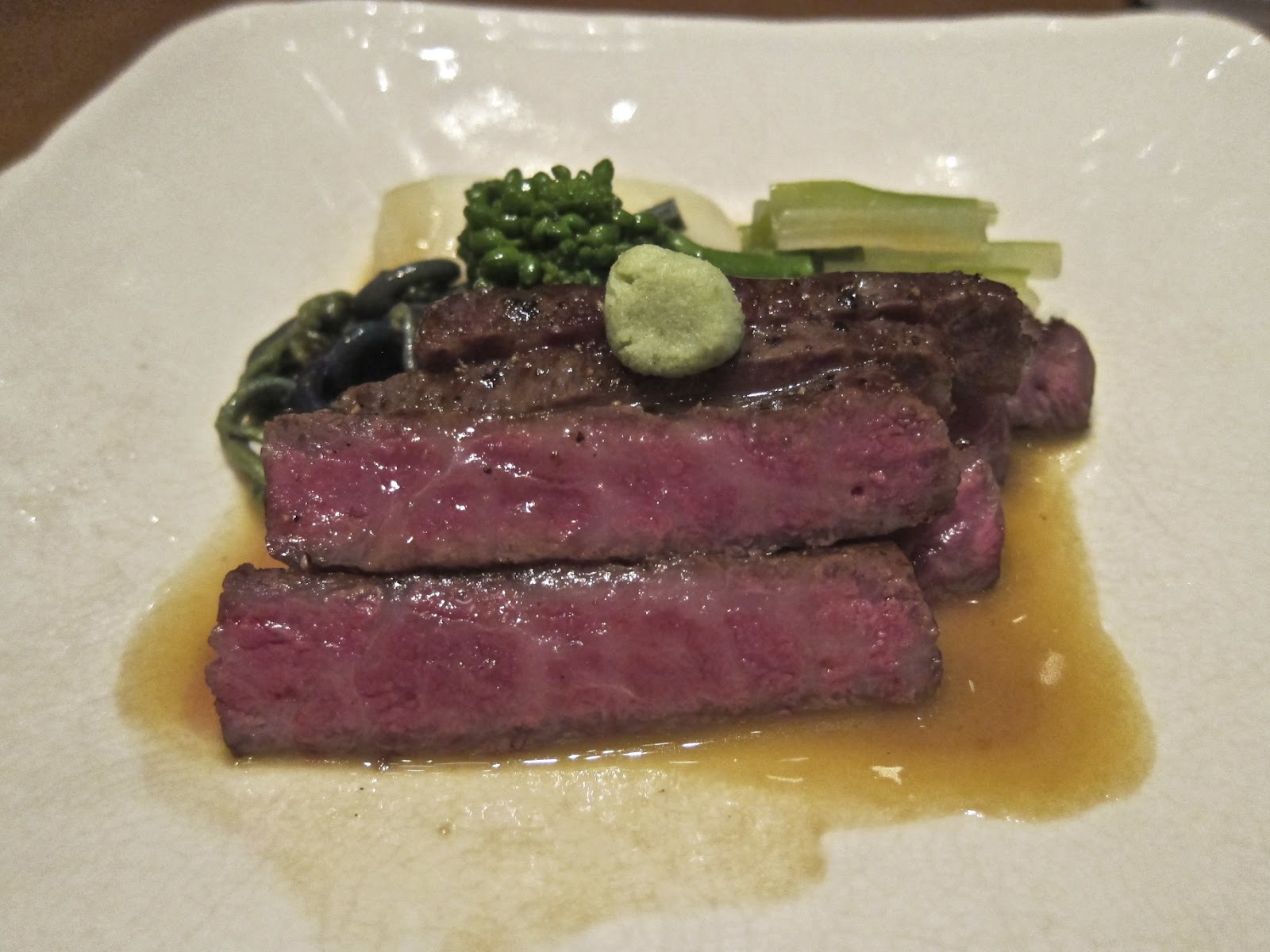


The beef was amazingly delicate and melt-in-the-mouth tender.
The soups had clear broths.
Salt pickled vegetables were simple and clean tasting.
Soba with duck broth and leeks, delicious.
The trip is crazy-short. Only one day in Tokyo, then a bullet train trip to Kyoto. Two days there, then back to Tokyo to return to LA.
Nutty and such great fun.
Here are some photographs from last night's dinner.
More to come.
Subscribe to:
Posts (Atom)