Tuesday, June 3, 2014

Arctic sea ice in steep decline

Arctic sea ice area is in steep decline. The yellow line on the image below shows the sea ice area for 2014 up to June 1st, showing an almost vertical fall over the past few days.

[ click on image to enlarge ]
The Naval Research Laboratory image below compares the May 14, 2014, sea ice concentration (left) with the sea ice concentration forecast for June 10, 2014 (run on June 2, 2014, on the right).

[ click on image to enlarge ]
The NOAA image below shows sea surface temperature anomalies on June 3rd, 2014.


The NOAA image shows the huge sea surface temperature anomalies all over the Northern Hemisphere on June 3rd, 2014. Large areas with sea surface temperature anomalies up to 8 degrees Celsius and higher show up in and around the Arctic Ocean

[ click on image to enlarge ]
The image below shows sea surface temperature anomalies up to 1.5 degrees Celsius over the May-June 2014 period, with global average anomalies that hover just above 1 degree Celsius.


Above sea surface anomalies are very high, much higher than historic annual temperature anomalies over land and oceans, as shown on the image below for comparison.


In conclusion, the situation spells bad news for the sea ice, also given the prospect of an El Niño event projected to occur later this year. As discussed in earlier posts, the sea ice is already very thin, and as this image shows, ocean heat is melting the sea ice from beneath, while the sun is warming up the ice from above. At this time of year, insolation in the Arctic is at its highest, as Earth reaches its maximum axial tilt toward the sun of 23° 26'. In fact, insolation during the months June and July is higher in the Arctic than anywhere else on Earth, as discussed at this earlier post.

Feedbacks further accelerate warming in the Arctic, as described in the earlier post Feedbacks in the Arctic. Temperature rises of the water close to the seafloor of the Arctic Ocean is very dangerous, as heat penetrating sediments there could cause hydrate destabilization, resulting in huge amounts of methane entering the atmosphere over the Arctic Ocean.


Father's Day Deserves a Feast, Start with the Grill

This year I will be out of town on Father's Day. I'll miss being with my sons on that special day. We already have a bealted-Father's Day date two weeks later when we will all be in town. I can hardly wait!

Since Father's Day coincides with the start of summer, grilling is the best way to celebrate male parenting.

For me, nothing is better than a platter of grilled Italian sausages with sautéed onions, deveined shrimp seasoned with olive oil, sea salt and black pepper, corn on the cob, charred red peppers mixed with capers and garlic and lobsters split open and doused with pats of sweet butter.  With a tossed arugula and carrot salad, a loaf of freshly baked bread and a fresh fruit salad and I am happy.
The best grilling is the easiest kind. Buy good sausages, seafood and chicken, drizzle with olive oil, season with sea salt, pepper and any dried herb you fancy, put it on a hot grill, turn diligently to prevent burning and serve when it's done.

When the boys come to the house to celebrate a birthday, mother's day or father's day, they frequently take command of the grill. As my younger son, Michael, reminds me, they are my sons so of course they are good cooks. And that makes me very very happy.

Our other son, Franklin, doesn't regard a meal a proper meal unless there are appetizers. The secret to a great grilled meal is what's served on the side. My contribution to your Father's Day celebration are three of my favorite sides. 

All three are addictive so you may find you'll be eating them all summer long. They are all easy-to-make. The tapenade and lavash crisps can be made a day or two ahead. The grilled corn salsa is best made fresh.


Grilled Corn Salsa

Adding corn caramelized from light grilling gives this salsa it’s distinctive sweetness. When you buy corn from the market, look for plump kernels. Avoid ears with wrinkled or shriveled kernels.
You can use any kind of ripe tomato you enjoy, but I prefer cherry tomatoes because they are sweet and they hold their shape after being cut up. For added color, select a basket with a mix of yellow and red cherry tomatoes.

Serves 4

Ingredients

1 ear of corn, husks and silks removed, washed
1 8 oz basket of ripe cherry tomatoes, washed, quartered
1 large shallot, ends and skin removed, washed and roughly chopped
½ cup Italian parsley, washed, leaves only, finely chopped
¼ teaspoon cayenne
2 tablespoons olive oil
Sea salt and black pepper to taste
Lemon juice to taste (optional)

Directions

Pre-heat the grill to medium-hot.

Drizzle the olive oil on a large plate and season with sea salt and black pepper. Roll the ear of corn to coat. Using tongs, place the corn on the grill.  Turn frequently to prevent burning.  Remove the corn when all the sides have light grill marks. Let cool. Cut off the kernels and place in a large mixing bowl.

Use a rubber or silicone spatula to transfer the seasoned olive oil from the plate into the mixing bowl with the corn.

Add the quartered cherry tomatoes, shallot and parsley. Toss well and season with the cayenne. Taste and adjust the flavors with more sea salt, black pepper, olive oil and lemon juice (optional).

Tapenade with Charred Garlic

A secret weapon in last minute cooking, tapenade brightens any meal either as an appetizer or a condiment. If you use pitted, canned olives, making tapenade will take 10-15 minutes.
 
The taste of your tapenade depends on the quality of the olives.

Serves 6-8

Ingredients

1 can pitted olives, drained weight 6 oz., preferably green or kalamata olives
2-3 tablespoons olive oil
2 garlic cloves with skins
¼ cup Italian parsley, washed, leaves only, roughly chopped
¼ teaspoon pepper flakes (optional)
Black pepper to taste

Directions

Skewer the garlic cloves on the end of a knife or a metal skewer and hold over a gas flame to burn off the outer skins. Let cool, remove any pieces of charred skin and roughly chop the cloves.

In a small blender or food processer, place the drained olives, olive oil, garlic, parsley and pepper flakes. Pulse until the olives are roughly chopped. Taste and adjust the seasoning with the addition of black pepper, sea salt, pepper flakes and olive oil.

Pulse again until the tapenade achieves the desired texture. Personally I like a tapenade that has a rustic look with the olives coarsely chopped rather than puréed.

Refrigerate until ready to use and serve at room temperature.

Variations

 2 anchovies packed in oil, roughly chopped and added with the olives. If salted, rinse before adding.

1 tablespoon capers added with the olives.

Lavash Crisps

Served in the Middle East, lavash and pita are commonly used instead of bread. Flat, unleavened lavash has a delicious, lightly grilled flavor when fresh. Making crisps makes use of lavash that might otherwise have gotten stale and gone to waste.
Lavash crisps have more flavor and are more flaky than commercially manufactured chips. Serve them with salsa, tapenade, dips or thin slices of cheese.

The crisps will last for weeks if kept refrigerated in an airtight container. 

Serves 6-8

Ingredients

1 large or 2 small sheets of lavash
1 cup olive or safflower oil
Sea salt and black pepper to taste
5-6 paper towel sheets

Directions

Cut the lavash sheets into 2” squares by cutting the sheet in half, placing the halves on top of each other, cutting those in half and doing that again until the pieces are 2” wide. Cut the 2” wide strips into 2” squares and set aside. If not cooked immediately, store in an airtight container.

In a large frying pan or griddle, heat ¼ cup of the oil. Season with sea salt and black pepper and heat on a medium-low flame. Be careful not to burn the oil or cause it to smoke.

Lay a paper towel sheet on a large plate or baking sheet.

Add the lavash squares to the hot oil. Do not overlap. Using tongs, turn over the lavash when they are lightly browned and cook the other side. They cook quickly so watch them closely.

Remove the cooked crisps and place them on the paper towel. Cook another batch. Place a clean paper towel on top of each layer to absorb excess oil.

Replenish the oil in the frying pan as needed and season with sea salt and black pepper. Allow the oil to reach the proper temperature before adding more lavash.

Discard the paper towels when the crisps cool. Store refrigerated in an airtight container. Serve at room temperature.

Obama's Power Plant Rules: Too Little, Too Late, Too Ineffective

On June 2, 2014, the Obama administration through the Environmental Protection Agency (EPA) announced that states must lower carbon dioxide (CO2) emitted for each unit (MWh) of electricity they produce.

1. Too Little

Under the EPA rules, the nationwide goal is to reduce CO2 emissions from the power sector by 30% from 2005 levels. This will also reduce other pollutants.
Sam Carana: The goal should be an 80% cut in emissions. Reductions should not be averaged out over different types of emissions, but instead the 80% reduction target should apply to each type of emission, i.e. 80% cuts in CO2 and 80% cuts in CH4 and 80% cuts in black carbon, etc.
2. Too late

Under the EPA rules, states must meet interim targets during the 2020s, but they can delay making emission cuts provided they will on average comply with targets by 2030. Moreover, the EPA suggests that they can from then on maintain that level subsequently.
Sam Carana: For over six years, I have been calling for an 80% cut in emissions by 2020. When people now ask if I still believe such reductions are feasible given the lack of action over the years, I respond that, precisely because so little has been achieved over the years, it now is even more imperative to set a target of 80% emissions cuts by 2020. If we start cutting 13.4% off this year's emissions, and keep cutting emissions by the same amount each subsequent year, we'll be under 20% (i.e. at 19.6%) by 2020. 
3. Too ineffective

Under the EPA rules, states could comply by either reducing CO2 emissions from their power plants or buying credits or offsets from elsewehere, e.g. through cap-and-trade programs. States can choose to use existing multi-state programs or create new ones.
Sam Carana: The goal should be a genuine 80% cut in emissions in each and every state. It is good to delegate decisions to states regarding what works best locally to achieve such reductions. However, schemes such as cap-and-trade, carbon credits and offsetting keep local polluters dirty by allowing them to claim credit for progress made elsewhere. A state buying credits from beyond its borders does not genuinely reduce its own emissions, making it even harder for it to reach its next targets (which should be even tighter), while also making it harder for targets to be reached elsewhere.  
The bigger such schemes grow, the more they become fraught with difficulties, twisted with irregularities and riddled with political chicanery, making them prone to fraud and bribery, often beyond the administrative scope and legal reach of local regulators. 
Such schemes are inherently counter-productive in that they seek to create ever more demand for polluting activities; they will continue doing dirty business until the last possible 'credit' has been sold, burning the last bit of fossil fuel from irrealistic carbon budgets that are fabricated inside the dark politics of compromise, campaign-funding and complacency. 
Such schemes are designed to profit from keeping the dirtiest power plants going and prolonging their lifetime beyond any reasonable purpose, in efforts to perpetuate the scheme itself and extract further money that, instead of being used to benefit the cleaner solutions, is then often used to finance further pollution elsewhere and spread the reach of such schemes. Such dreadful conduct is typically hidden away in a web of deceit custom-made to avoid the scrutiny of public accountibility.
And what if states fail to reach targets? The EPA suggestion to use such schemes effectively delays much local action, while encouraging states to negotiate with each other. This opens up the prospect of states blaming each other and taking legal action rather than genuine action. If the trappings of such schemes make states fail to reach targets, penalties could be imposed, but that still does not guarantee that targets will be reached; furthermore, given the complexities of such schemes, policing them poses additional burdens on administrators, police, courts and lawyers. Huge amounts of money and time have already been spent on court cases to postpone action, rather than on building genuine solutions.  
The best way to cater for non-compliance is to prepare federally-administered fees, to be levied on sales of polluting products, and with the revenues used to fund federal projects that do reduce emissions. As said, it's good for the EPA to encourage states to each work out how best to reduce their respective emissions, provided that each state does indeed reach set targets. Where a state fails to take the necessary action, the EPA should resume control and call for federal fees to be imposed in the respective state. 
The Clean Air Act calls for the 'best system of emissions reduction' to reduce emissions from power plants. The best system is one that levies fees on pollution and then uses the revenues to fund rebates on the cleaner products sold locally.  
Such combinations of fees and rebates (feebates) are the most effective way to make our economy sustainable, as part of the comprehensive action that is needed to avoid climate catastrophe. For more details on comprehensive and effective action, see the ClimatePlan blog. 

Related

- Methane Man
http://arctic-news.blogspot.com/2014/01/methane-man.html

- Climate Plan
http://climateplan.blogspot.com

Sunday, June 1, 2014

Support methanetracker.org

by Harold Hensel


I keep thinking of this experience when I see that methane has now blanketed the entire globe with the highest concentrations in the northern hemisphere. I was signing up a young man for property insurance. We discussed coverage's and how much coverage he needed. We got almost to the end of the routine underwriting questions and I got to the one about if he had ever been convicted of arson. He said yes! Then he said, do you think that will make a difference? Do we think that the globe being blanketed with methane will make a difference?

Methanetracker.org is an important service and it is brought to you by one person, Omar Cabrera from Houston. There is nothing else like it on the internet. He has spent $30,000 of his own money to make methanetracker.org free to the public. He feels this strongly about the methane issue. If you notice the slider bar, it stops at 4/20/2014. He needs to upgrade and has run out of money to do it. He has not asked for money until he ran out of money. Methanetracker.org is very important and he should not be trying to go it alone. I think we should chip in to help him keep methane tracker going. He doesn't need that much. How to help is on the http://www.methanetracker.org/ web site.

Saturday, May 31, 2014

How many deaths could result from failure to act on climate change?

A recent OECD study concludes that outdoor air pollution is killing more than 3.5 million people a year globally. The OECD estimates that people in its 34 Member countries would be willing to pay USD 1.7 trillion to avoid deaths caused by air pollution. Road transport is likely responsible for about half.

A 2012 report by DARA calculated that 5 million people were dying each year from climate change and carbon economies, mostly from indoor smoke and (outdoor) air pollution.

Back in 2012, a Reuters report calculated that this could add up to a total number of 100 million deaths over the coming two decades. This suggests, however, that failure to act on climate change will not cause even more deaths due to other causes.

Indeed, failure to act on climate change could result in many more deaths due to other causes, in particular food shortages. As temperatures rise, ever more extreme weather events can be expected, such as flooding, heatwaves, wildfires, droughts, and subsequent crop loss, famine, disease, heat-stroke, etc.

So, while currently most deaths are caused by indoor smoke and outdoor air pollution, in case of a failure to act on climate change the number of deaths can be expected to rise most rapidly among people hit by famine, fresh water shortages, as well as wars over food, water, etc.

How high could figures rise? Below is an update of an image from the earlier post Arctic Methane Impact with a scale in both Celsius and Fahrenheit added on the right, illustrating the danger that temperature will rise to intolerable levels if little or no action is taken on climate change. The inset shows projected global number of annual climate-related deaths for these two scenarios, i.e. no action and little action, and also shows a third scenario of comprehensive and effective action that would instead bring temperature rise under control.

[ click on image to enlarge ]
For further details on a comprehensive and effective climate plan, see the ClimatePlan blog.


Wednesday, May 28, 2014

Authentic Guatemalan Ceviche and Mexican Ice Cream on West Pico Near Crenshaw

Anyone who lives in Los Angeles knows this is a great city to enjoy ethnic food. It is easy to eat affordably priced meals at any number of national and regional restaurants including those that serve Chinese, Japanese, Mexican, Brazilian, Thai, Jewish, Korean, Vietnamese, Armenian, Persian, Peruvian, Guatemalan, Ethiopian and Indian dishes. 

Living near the beach, I don't come into town as often as I would like. To meet a friend close to where he lives meant we needed to find a restaurant near the 10 Freeway at the Crenshaw Boulevard exit.
Not knowing where to go, I turned to Bobby Rock, who knows the area well. He had suggestions.They all sounded good. We wanted a light meal, so we figured we'd try La Cevicheria (3809 W Pico Blvd, Los Angeles, CA 90019, (323) 732-1253).

As I parked in front of the restaurant, my friend called to say he would be late. A car issue, easily solved in ten to fifteen minutes. Ok, no problem. That gave me time to explore the area. 

Across the street, Jay's Market (4000 W. Pico Boulevard, Los Angeles 90019) is a Latin grocery store with a really good fresh produce section, a meat market with Mexican cuts and a well-stocked liquor department. I mention the latter because I really enjoy Quezalteca Especial, a grappa-like, Guatemalan white rum I used to buy from Golden Farms (6501 San Fernando Road, Glendale, CA 91202), an Armenian supermarket in Glendale near Adana (6918 San Fernando Road, Glendale, California 91201, 818-843-6237), an excellent Armenian restaurant I've written about. 
Golden Farms stopped selling the rum last year. Jay's Market carries it. Not knowing when I would be back in the area, I bought two bottles.

Back to La Cevicheria. 

Ethnic restaurants in LA are often family run and draw heavily on the home cooking taught by one generation to the next. Serving the local community, La Cevicheria reached a wider audience when the restaurant was reviewed positively by Jonathan Gold, LA's premier ethnic restaurant critic, and included by S. Irene Virbila in her ceviche round-up. 

Waiting for my friend, I sat down at one of the two small sidewalk tables to read the newspaper. Enjoying a quiet moment, even though a large truck was idling in front while the driver made a delivery, a man in a black t-shirt stuck his head out of the restaurant's front door to ask, "May I help you?" "Just waiting for my friend," I explained. He invited me inside because sitting next to an idling truck wasn't all that pleasant.

At that moment, my friend arrived, so inside we went and found a table in the middle of the restaurant. The man in the black t-shirt handed us menus and introduced himself as Julio Orellana.  He waved his arm in the air, gesturing at Jonathan Gold's review on the wall. He was happy to meet us, he said, although the person we really should meet was chef Carolina Orellana, his wife, but she was not there. 

A gregarious person, Orellana gave us a thumbnail description of the restaurant. The recipes came from Guatemala. Carolina made everything in the kitchen. Ok. there were a few hot sauces in bottles because people fancied them, but everything else was made in the kitchen, the way his wife cooked for the family at home.

We read the menu. Hip hop music played overhead. More people came into the restaurant. The truck deliveryman came inside and found an empty table. A woman, her mom and a friend sat across from us. She ordered and when her food came, she told us about the dishes.

La Cevicheria is the kind of place where people start conversations with strangers. Everyone wants to talk about their favorite dishes.
The woman told us we should order the Chapin, described in the menu as "Guatemalan style with shrimp, crab, octopus, tomatoes, onions, avocado, mint, lime, Worcestershire sauce" ($12) and the Campechana ("shrimp, bloody clams, octopus, abalone, tomatoes, cucumbers, onions, cilantro, avocado") served with crisp corn tortillas ($12). 

She also told us that because La Cevicheria doesn't have a liquor license, we could bring our own beer in brown paper bags. But, no bottles, only beer in cans. 

We shared a plate of Aguachiles, a ceviche appetizer with 4 jumbo raw shrimp, deveined, the shells peeled back to the tails. The shrimp were placed in a thick, spicy-hot green sauce, flavored with pulverized jalapeños, lime, cilantro, onions and garlic. The translucent shrimp quickly turned pink under the withering glare of the jalapeño-lime marinade. The heat surrounded the sweet shrimp and coated the inside of my mouth. The dish satisfied on so many levels. 

We had the Campechana. Arriving in an unglamorous, large metal bowl, bits of shrimp, clams, octopus and abalone float in an ink-dark liquid. Lacking the visual appeal of the Aguachiles, the Campechana cocktail needs to be eaten to be appreciated. Cilantro, avocado and peeled cucumbers brighten the seriousness of the ceviche. Eaten on pieces of crisp corn tortilla, each mouthful becomes an experience of contrasting textures and flavors--crisp, soft, chewy, sweet, acidic. After each bite, mouth empty, a quiet heat envelopes your palate like the sweet remembrance that comes when a lover leaves and you yearn with anticipation for her return. 
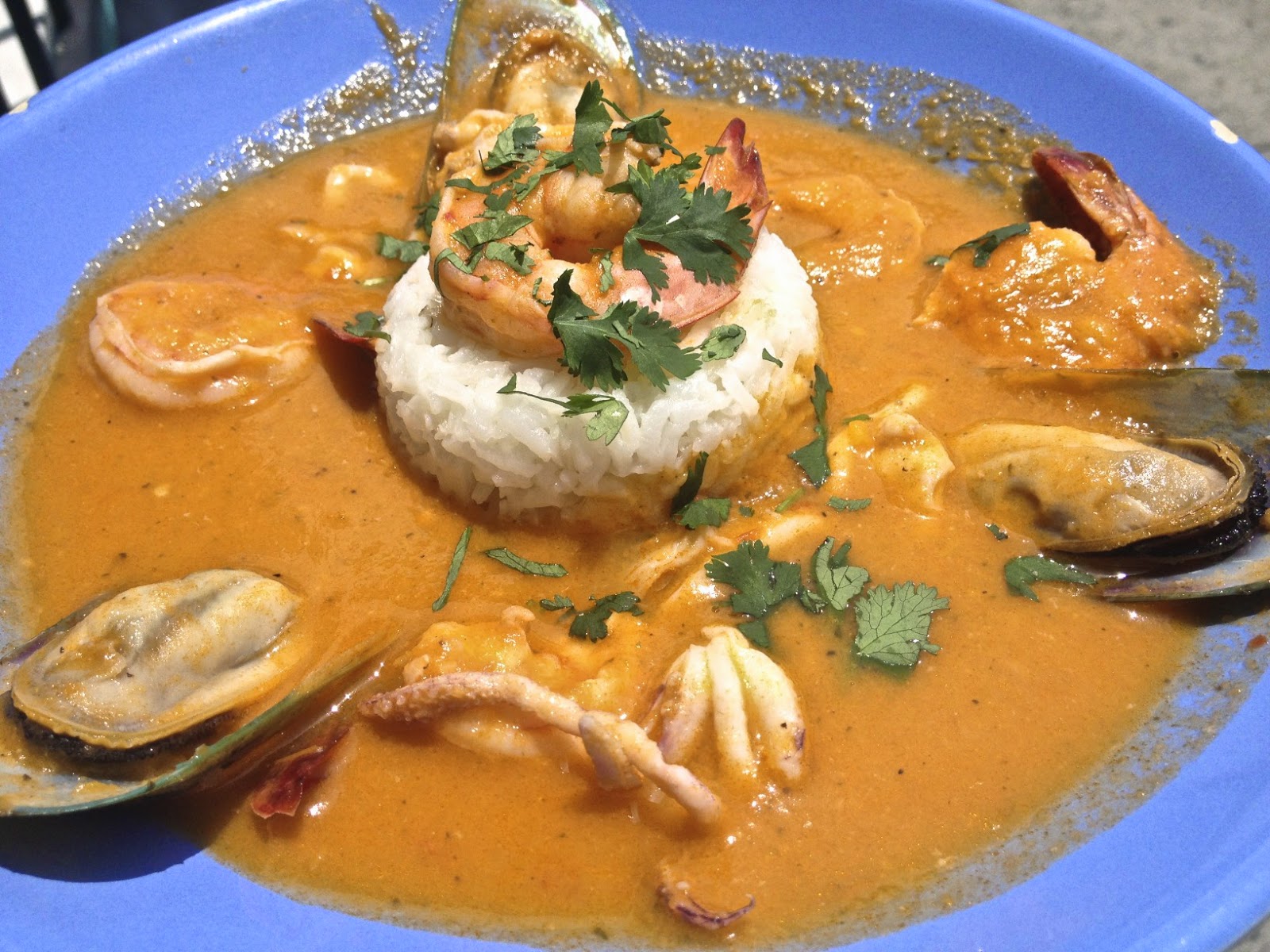
As a contrast to the two first dishes, the Mariscadas, a seafood stew is an intermezzo of quiet. Served in a mild tomato based sauce with steamed white rice ($15), the dish is visually elegant and easy on the palate, as if to say, Guatemalan cuisine isn't all about heat. Mariscadas comforts where its companions sought to excite and challenge.

Providing a through line for all the dishes, we had glasses of freshly squeezed, tart-sweet limeade.

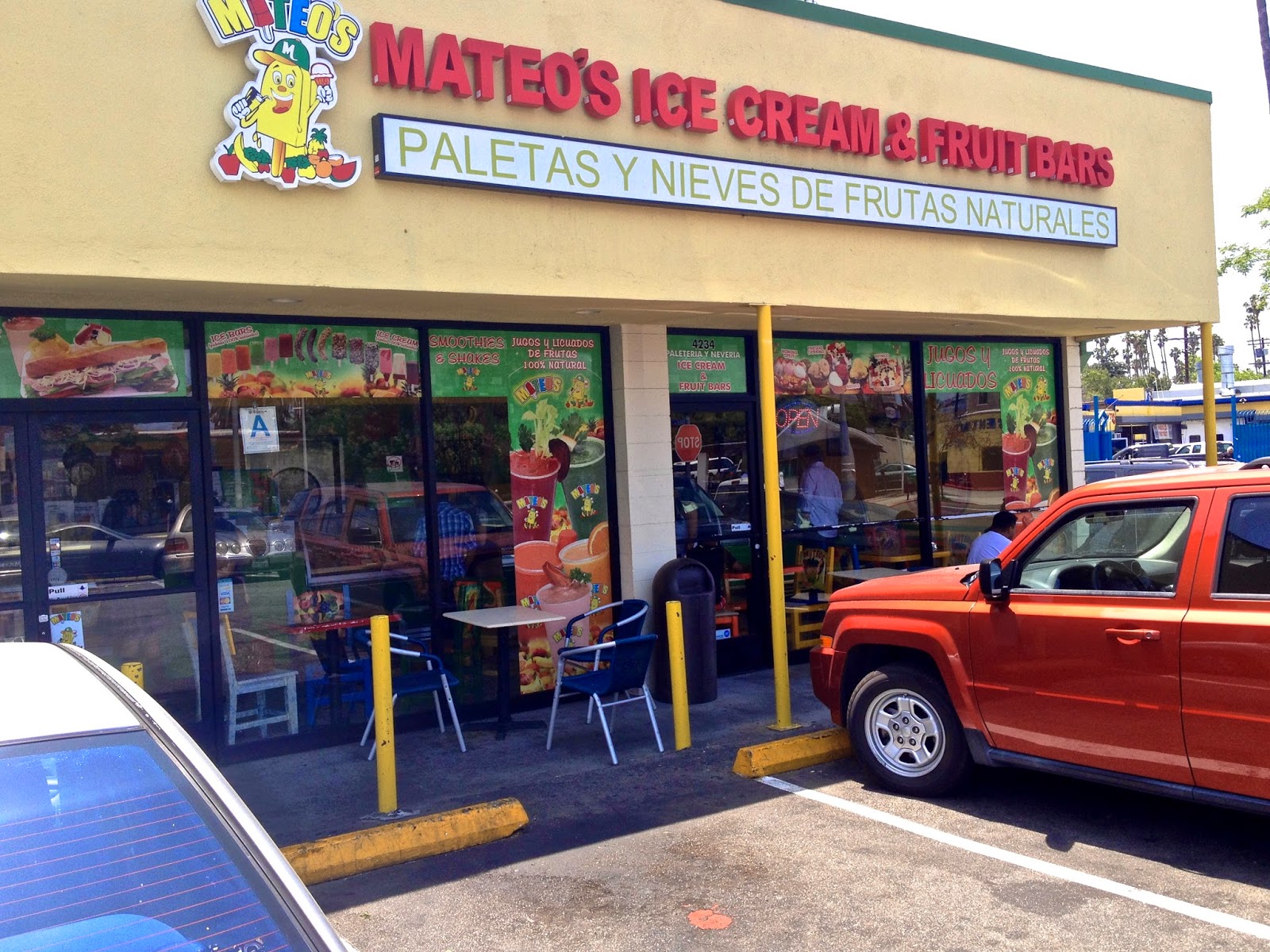
After all the heat, we needed something sweet. My friend remembered Mateo's, an ice cream store on Pico, just west of Crenshaw. 

As we walked to our cars, we passed Restaurante Puerto La Union (3811 W. Pico Boulevard, Los Angeles 90019, 323/373-0429). A quick look at the menu with its list of affordable, large plates of familiar Salvadorian dishes and we knew we would come back. Maybe next time we would have appetizers at La Cevicheria (surf) and an entrée at Restaurante Puerto La Union (turf).
Mateo's Ice Cream has three locations (1250 S. Vermont Avenue, #105, Los Angeles 90006, 213/738-7288 and 4929 S. Sepulveda Boulevard, Culver City 90230, 310/313-7625). We stopped at the West Pico store (4234 W. Pico, Los Angeles 90019, 323/931-5500). 

The ice creams and paletas (fruit bars with and without milk) are made in the Culver City store. All use fresh ingredients. When paletas are made right, they are sweet but not too sweet. They are all about flavor. 
The flavors are familiar--vanilla, pistachio, caramel, rum with raisins, egg nog with raisins, neapolitan, banana split, coffee, strawberry, banana and lemon. And not so familiar--mamey sapote, melon, pepino and chile, watermelon, smoked milk, tamarind and chile, pitaya, nance, tejocote, yogurt and dried fruit, guanabana, mango and walnut. 

Mateo's is rightly proud of their ice creams.

Besides ice cream scoops, fruit bars (paletas), smoothies, milkshakes and freshly squeezed juices, Mateo's also has a short menu of sandwiches so if you are hungry you can eat before you feast on ice cream treats.
I had a vanilla paleta with strawberries. Delicious. My friend had scoops of smoked milk and caramel. I wanted to try the coconut, pineapple and mango with chile paletas but after the lunch at La Cevicheria, I was too full.

I'm looking forward to my next visit to West Pico and Crenshaw.

Sunday, May 25, 2014

Large Falls in Arctic Sea Ice Thickness over May 2014

Comparing ice thickness (in meters) on May 2, 2014 (left) and May 30, 2014 (right, forecast run May 25, 2014)
Arctic sea ice has shown large falls in thickness in many areas over the course of May 2014, as shown on above image. The animation below also compares the situation between May 2, 2014, and May 30, 2014 (as forecast by Naval Research Laboratory on May 23, 2014). Ice thickness is in meters.


Thickness is an important indicator of the vulnerability of the ice. If only looking at sea ice extent, one might (wrongly) conclude that sea ice retreat was only minor and that everything looked fine. By contrast, when looking at thickness, it becomes evident that large falls have occurred over the course of May 2014.

Falls at the edges of the sea ice can be expected at this time of the year, but the large fall closer to the center is frightening. On the one hand, it appears to reflect cyclonic weather and subsequent drift of the ice. On the other hand, it also indicates how vulnerable the sea ice has become. Last year, a large area showed up at the center of the sea ice where the ice became very thin, as discussed in July 2013 in the post Open Water at North Pole and again in the September 2013 post North Hole.

The appearance of huge weak areas at the center of the sea ice adds to its vulnerability and increases the prospect of total sea ice collapse, in case of one or more large cyclones hitting the Arctic Ocean later this year. To highlight the dangerous situation, the main image from a post earlier this month is again added below.


Adding to the concerns are huge sea surface temperature anomalies, as illustrated by the image below, showing anomalies at May 23, 2014, and created by Harold Hensel with ClimateReanalyzer and Google Earth.

[ click on image to enlarge ]
The image below shows sea surface anomalies on May 26, 2014, with an overlay of land temperatures, as created by Harold Hensel and edited by Sam Carana.


The image shows sea surface temperatures on the Northern Hemisphere that are 1.44 degrees Celsius warmer than the baselline temperature, despite large areas with cold water partly resulting from the huge amounts of meltwater flowing down along the edges of Greenland into the North Atlantic Ocean. The graph below shows Northern Hemisphere and Global sea surface temperature anomalies over May 2014.

By comparison, current (May 27, 2014) surface temperature anomalies of 0.64°C globally and 0.84°C for the NH. The image below shows annual temperature anomalies (land and ocean data).


Meanwhile, the development of this year's 'north hole' at the center of the sea ice appears to persist, as illustrated by the image below.